Trump Threatens To Send US Citizens To The Worst Prison On Earth And Inmates Must Obey This One Terrifying Rule
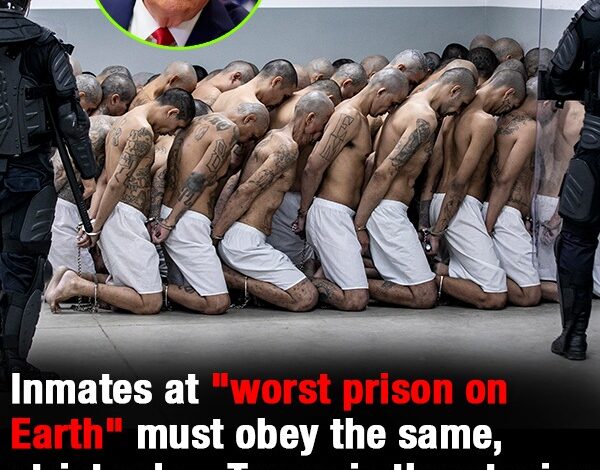
The Centro de Confinamiento del Terrorismo, commonly known by its Spanish acronym CECOT, has rapidly become the ultimate symbol in the global debate surrounding punishment, state security, and human rights. Built as a high-security mega-prison in El Salvador during the country’s aggressive and widely publicized crackdown on violent gangs, the facility is designed to house thousands of individuals accused of gang-related activities. Today, it stands as an imposing fortress of concrete and steel, heavily fortified and equipped with cutting-edge surveillance technology to ensure total containment. The sheer scale of the facility reflects the government’s determination to isolate the most dangerous elements of society from the general public, turning the arid landscape into a monument of modern penal architecture.
When people hear descriptions of the facility, they are often stunned by the extreme conditions under which inmates are forced to live. The prison is characterized by absolute isolation, severely limited movement, and relentless monitoring. The living conditions are tightly regulated, with highly controlled routines that strip away almost all personal freedoms. Inmates are confined to cramped, sparse cells, and outdoor time is an extreme rarity rather than a daily privilege. The food is rationed, medical access is restricted, and communication with the outside world is completely non-existent for the vast majority of the prison population. Supporters of the system argue that these harsh, uncompromising measures are absolutely necessary to dismantle criminal organizations, reduce violent crime, and restore a sense of public safety to a nation that was once considered one of the most dangerous places on the planet.
At the heart of the daily operation at CECOT is a single, strict, and unyielding rule that every inmate must obey: total, unwavering submission to the authority of the prison guards. This rule permeates every aspect of existence inside the facility, dictating when prisoners stand, sit, and even how they move through the hallways. Any deviation from the established routine or the slightest sign of resistance is met with immediate, severe consequences. This level of extreme control is designed to break the psychological hold of the gangs and force the inmates to realize that the state, not the criminal organization, is in charge of their lives. It is a calculated exercise in stripping away the identity and influence that these individuals once held on the streets, replacing it with rigid conformity.
The broader context of CECOT’s creation involves El Salvador’s government declaring a nationwide state of emergency. This sweeping security strategy gave law enforcement extraordinary powers to round up suspected gang members en masse. As a result of these mass detentions, the country experienced a dramatic and unprecedented drop in homicide rates. For supporters of the government’s approach, these statistics are undeniable proof of the strategy’s success. The streets, once dominated by extortion and bloodshed, have become significantly safer for ordinary citizens. Businesses can now operate without paying gang taxes, and families can walk through their neighborhoods without the constant fear of violence and random acts of intimidation.
However, this dramatic reduction in crime has come at a massive moral and legal cost, drawing sharp criticism from international human rights organizations and legal experts. The primary concern revolves around the lack of due process and the nature of the mass detentions. Many critics argue that thousands of individuals are held in CECOT without having undergone full, fair legal trials. In the rush to clear the streets, the system has inevitably swept up individuals who may have had no actual connection to criminal activity, leading to wrongful incarcerations. This raises serious questions about fairness, legality, and the potential for severe abuses of state power that could haunt the country for generations.
The prison has thus become deeply controversial, transforming into a flashpoint in the global discussion on how modern governments should respond to organized crime and domestic violence. Supporters view the harsh methods as a pragmatic and necessary approach to an extreme threat, arguing that traditional legal systems are simply too slow and corrupt to handle the scale of gang violence. Critics, on the other hand, warn that sacrificing individual rights in the name of security is a dangerous and slippery slope. They argue that once a government suspends basic human rights for one group of people, it sets a dangerous precedent that could eventually be used against any citizen, effectively turning a democratic nation into an authoritarian state where no one is safe from arbitrary detention.
The situation took a shocking turn when former United States President Donald Trump began using CECOT as a talking point in American political debates. Threatening to send certain US citizens to the notorious prison, he brought the debate directly to American shores and into the living rooms of millions. Such rhetoric highlights a growing fascination among some political figures with the extreme measures used abroad. However, the idea of an American citizen being subjected to the harsh, rights-denying conditions of CECOT has sparked fierce debate and alarm among constitutional scholars, human rights advocates, and everyday citizens who fear the erosion of their own legal protections.
Ultimately, CECOT represents a much larger, global tension between the desire for public safety and the protection of civil liberties. It forces the world to confront a profoundly difficult and uncomfortable question: how far should a government go in the name of security, and what specific safeguards must remain in place to protect justice, fairness, and human dignity? The debate over CECOT is not just about a single prison or a single country; it is a critical reflection on the future of justice in a world that is increasingly willing to trade freedom for safety.




0 comments:
Post a Comment