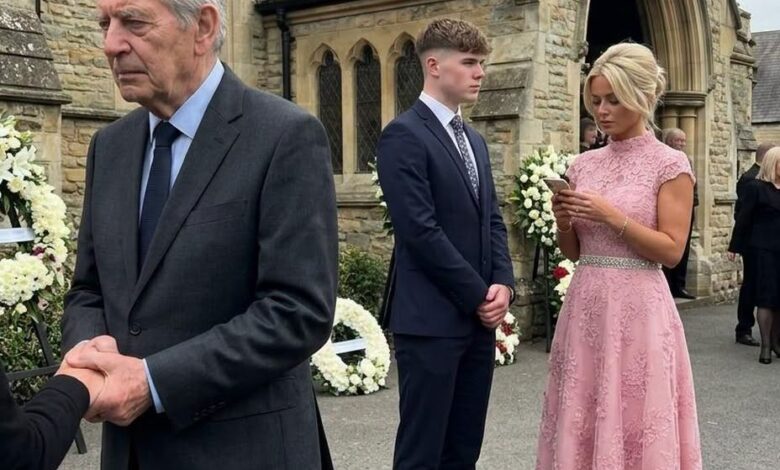
The morning of my wife Elena’s farewell service arrived with a blinding, almost mocking brilliance. The sky was an unblemished, vibrant blue, and the sunlight poured generously through the towering stained-glass windows of the memorial hall, casting kaleidoscopic patterns on the floor. It felt entirely wrong. The world outside should have paused, should have recognized that the brightest light in my universe had been extinguished. Yet, life continued its relentless march, indifferent to the gaping void in my chest. Friends, colleagues, and distant relatives began to fill the room, their faces etched with solemnity. They approached me with soft, hushed voices, offering condolences that were well-meaning but ultimately hollow against a grief so profound that it resisted translation into mere words. I nodded, mechanically murmured my thanks, and accepted their embraces, though internally, I felt as if I were observing the proceedings from behind thick glass, detached and utterly numb.
When my son Daniel finally arrived, his sorrow was palpable, etched into the very slope of his shoulders. His footsteps were heavy and hesitant as he walked down the center aisle. He stopped briefly to apologize for being late, his voice catching and trembling as he spoke. I pulled him into a tight, lingering embrace, feeling his trembling frame against mine. In that quiet moment, I was acutely aware that all the sympathy in the world could not bridge the chasm of his pain. Elena was his anchor, and now he was unmoored. Moments later, Vanessa joined us. She stood in stark contrast to Daniel’s raw, unfiltered grief. Every hair was perfectly in place, her posture impeccably straight, and her expression carefully composed. While Daniel wore his heart on his sleeve, Vanessa’s presence felt like a shield of polished obsidian, smooth and impenetrable.
My mind drifted back to the grueling, exhausting year we had just endured. During Elena’s lengthy illness, Vanessa had been a frequent visitor at our home, dropping by several times a week. Yet, looking back, I realized that her visits were rarely anchored in the pursuit of emotional connection or comfort. She did not sit by Elena’s bedside to hold her hand, nor did she engage in the kind of late-night conversations that bring people closer to the edge of mortality. Instead, Vanessa’s demeanor was relentlessly pragmatic. Her conversations invariably drifted toward the logistical and the tangible, focusing on legal documents, financial planning, medical directives, and the future arrangements that inevitably follow a terminal diagnosis. At the time, I had excused it as a coping mechanism, a way for her to process the unimaginable. But looking at her now, something about her distant, sterile tone still nagged at the back of my mind, a subtle dissonance that felt completely separate from the emotional weight of the tragedy we were living through.
During the service, Daniel stood like a statue of quiet strength. He kept his emotions locked tightly inside, refusing to let the dam break. It was a stoicism he had learned from his mother. I watched from the corner of my eye as Vanessa leaned forward, whispering something into Daniel’s ear. A brief, sharp flash of tension crossed his face, a fleeting moment of annoyance or resistance before he smoothed it over with a practiced, hollow smile. He chose not to engage, prioritizing the peace of the day over whatever confrontation Vanessa seemed to be inviting. It was a testament to his maturity, yet it left me wondering about the hidden currents beneath the surface of our family dynamic. As the service concluded and the last somber note of the organ faded away, we filed out toward the cemetery, the reality of our new, diminished reality beginning to sink in.
The journey to the cemetery was a silent procession. Standing by the gravesite, the finality of the burial settled over us like a heavy, suffocating blanket. The casket descended, the earth was turned, and the last of the mourners paid their respects before slowly drifting away until it was just Daniel and me. I lingered by the grave, staring at the polished wood, desperately trying to comprehend a loss that felt too large and too complex for my mind to fully grasp. The stillness of the afternoon felt ominous. It suggested that from this point forward, the jagged edges of grief would simply become a permanent fixture in my life, a heavy burden I would be forced to carry. I felt a profound sense of hopelessness, believing that the darkest days were behind me and that I was merely stepping into a future devoid of warmth.
Just as we were preparing to turn our backs and walk away from the gravesite, a familiar figure approached us. It was our family attorney, Mr. Harrison. He held a leather briefcase in his hand and wore a somber, respectful expression. He cleared his throat, addressing us with a quiet urgency. He explained that Elena had left specific instructions regarding the execution of her estate. She had requested that her will be read immediately following the funeral, with all of us present in his office. A confused murmur rippled through the small group, but there was nothing to do but comply. An hour later, Daniel, Vanessa, and I found ourselves seated in the plush, wood-paneled office of the attorney, the tension in the room thick enough to cut with a knife.
The lawyer began to read the document, his voice a steady, rhythmic drone that filled the quiet space. At first, the reading was exactly what I had expected. It was filled with thoughtful, meticulously organized decisions that reflected the deep care and consideration Elena always showed for our family in life. There were provisions for Daniel’s future, arrangements for the estate, and fair distributions that left no room for ambiguity. We nodded along, finding a strange comfort in the familiar, practical guidance of her hand. Then, the lawyer paused. He set the main document aside, reached into his briefcase, and withdrew a thick, sealed envelope made of heavy parchment paper. He held it up, announcing that Elena had prepared it herself and requested it to be read aloud as the final part of the process.
As the lawyer broke the wax seal and began to read her words, the entire atmosphere of the room shifted dramatically. Her handwriting, elegant and familiar, translated through the lawyer’s voice into a living presence. It was something deeply personal, reaching far beyond the cold, formal arrangements of a legal document. She spoke not of assets or properties, but of the values she wanted us to carry forward. She addressed the unspoken tensions, the hidden misunderstandings, and the deep love she had for each of us. In that transformative moment, it became blindingly clear that even from beyond the veil, Elena had chosen to guide us through our darkest hours. She had given us not just an inheritance, but a profound understanding of what truly matters in this world, showing us how to step out of the shadows and move forward together.


0 comments:
Post a Comment