Top Ad 728x90

Saturday, April 18, 2026

-We’ll be keeping our eyes peeled👀🔽

by


“Check Your Pocket Change Carefully — A Rare Lincoln Penny, Mistakenly Circulated Decades Ago and Now Valued at an Astonishing $336,000, Could Be Sitting Unnoticed in Your Coin Jar, Offering Everyday Americans the Chance to Discover a Hidden Treasure Worth a Small Fortune in Ordinary Spare Change.”

Among the most legendary numismatic rarities in American history, the 1943 Bronze Lincoln Cent stands as a symbol of both minting error and historical fascination. Struck during the height of World War II, this coin became famous because it should never have existed at all. In 1943, the United States Mint switched from bronze (a copper-based alloy) to zinc-coated steel for the production of pennies in order to conserve copper for wartime materials such as shell casings, telephone wire, and military equipment. However, a small number of bronze planchets — the blank metal discs used to strike coins — were accidentally left in the minting presses from the previous year. When these leftover bronze blanks were fed into the presses intended for the new steel cents, a handful of 1943 pennies were minted in bronze rather than steel, resulting in one of the most remarkable minting mistakes in U.S. history. When examples of these coins first appeared in circulation in 1947, they ignited an immediate wave of public fascination. Stories spread like wildfire about the “copper 1943 penny,” a coin so rare and mysterious that many people began inspecting every penny in their pockets, hoping to stumble upon a fortune in loose change.

The appeal of the 1943 Bronze Lincoln Cent lies not only in its extreme rarity but also in its historical context. The war years had profoundly shaped American industry, economy, and daily life, and even something as small as a one-cent coin reflected the nation’s efforts to mobilize every available resource. The decision to replace copper with steel was a practical measure taken under the War Production Board’s orders, but it inadvertently created the conditions for one of the mint’s most famous accidents. Experts estimate that no more than 20 bronze 1943 cents were ever struck across all three mints — Philadelphia, Denver, and San Francisco. Each carries unique characteristics that make it possible to identify where it originated. The Philadelphia examples lack a mintmark, while the Denver and San Francisco pieces are marked with a small “D” or “S,” respectively. Because so few were made and even fewer have survived in good condition, collectors prize these coins as the “Holy Grail” of Lincoln cents. One example of the Philadelphia issue sold at auction in 2010 for $1.7 million, and another specimen, once owned by a teenager who discovered it in his lunch money, fetched over $200,000 decades later. These astonishing prices continue to stoke public fascination, ensuring that the story of the bronze 1943 cent endures across generations.

When the first examples surfaced in the late 1940s, confusion and disbelief initially surrounded their authenticity. The U.S. Mint publicly denied that any bronze cents had been struck in 1943, attributing reports to plating errors or counterfeits. However, as verified specimens underwent metallurgical testing and careful authentication, experts confirmed that the coins were indeed genuine errors produced by the mint. Each 1943 bronze cent is composed of roughly 95% copper and 5% tin and zinc, the same composition used for regular pre-war Lincoln cents. By contrast, the standard 1943 steel cents were made of zinc-coated steel and carried a distinctive silvery appearance that often rusted over time. The visual contrast between the brownish-red bronze cents and their silvery counterparts made the errors instantly recognizable to trained eyes. As coin collectors and the general public began hunting for these elusive pennies, the story grew into an American treasure hunt. Children and adults alike scoured their change, magnet in hand (since the steel cents were magnetic and the bronze ones were not), hoping to discover one of these “phantom” coins. The hunt became so widespread that the Mint eventually issued statements to clarify that the vast majority of 1943 bronze cents advertised were either fake copper-plated steel coins or altered 1948 cents with the “8” reshaped into a “3.” Genuine examples, though exceedingly rare, were soon cataloged by professional numismatists and museum curators, cementing their legendary status.

Beyond its monetary value, the 1943 Bronze Lincoln Cent serves as a tangible artifact of America’s wartime economy and industrial ingenuity. Every detail of the coin — from Abraham Lincoln’s bust on the obverse to the wheat stalks on the reverse — carries the patina of a nation under strain yet united by purpose. Its bronze surface, now aged with a soft reddish-brown hue, contrasts sharply with the silvery steel issues of the same year, making it a striking reminder of the brief moment when necessity altered even the smallest elements of American life. The accidental survival of a few bronze blanks speaks to the complexities of large-scale minting operations during a period of transition. Mint workers in 1942 had produced billions of copper cents, and it is believed that a few leftover planchets simply stuck inside the hoppers or minting machinery. When the presses were reloaded with the new steel planchets, these stragglers were struck inadvertently, escaping notice and entering circulation undetected. This unintentional blending of eras — a 1942 metal composition bearing a 1943 date — symbolizes both human oversight and the fascinating unpredictability of mass production. Each surviving specimen thus embodies not only historical value but also a story of chance, discovery, and enduring intrigue.

As decades passed, the legend of the 1943 Bronze Lincoln Cent only grew stronger. It became a fixture in popular culture and numismatic lore, often featured in magazines, television programs, and treasure-hunting guides. Coin dealers began using it as the quintessential example of how small minting errors can become objects of immense desire. Even today, collectors and historians cite it as one of the “Big Three” U.S. coin rarities, alongside the 1913 Liberty Head nickel and the 1804 Draped Bust silver dollar. The coin’s mystique has also been fueled by stories of ordinary people who stumbled upon fortunes by chance. One of the most famous cases involved a Massachusetts teenager named Don Lutes Jr., who discovered a 1943 bronze cent in his change at his high school cafeteria in 1947. Though he held onto it for decades, never selling it during his lifetime, the coin was eventually authenticated and sold at auction in 2019 for over $200,000, with proceeds donated to charity. Such stories reinforce the romantic idea that unimaginable treasures might still lurk in everyday life, waiting to be found. Meanwhile, counterfeiters have continued to exploit public fascination, producing thousands of imitation coins, many of which circulate among novice collectors or appear in online marketplaces. Genuine examples, however, remain meticulously documented and traceable, their ownership often recorded through generations of prominent collectors and auction houses.

In the broader context of American history, the 1943 Bronze Lincoln Cent represents more than just a numismatic curiosity — it is a reflection of how national events can leave imprints even on the smallest details of daily life. The coin’s existence reveals the logistical challenges faced by the U.S. Mint during wartime, the adaptability of American manufacturing, and the enduring cultural fascination with rarity and error. Its story bridges economics, technology, and human emotion, reminding us that mistakes can sometimes yield masterpieces. Today, authenticated examples of the bronze 1943 cent are housed in major collections, including those of the Smithsonian Institution and the American Numismatic Association, while others reside in private hands. Each time one surfaces at auction, headlines proclaim its astonishing price and renew the public’s collective curiosity. The coin’s journey — from an accidental creation born of war to a multimillion-dollar collector’s item — mirrors the unpredictable intersections of history and chance. For both seasoned numismatists and casual enthusiasts, the 1943 Bronze Lincoln Cent endures as a testament to the power of a small object to capture the imagination of an entire nation.

My neighbor and I have a shared fence, which he painted purple without my permission. I don\'t even like purple fences, but he says everyone paints them purple for a reason. I was so angry that I couldn\'t even ask what it means. What\'s the meaning behind purple fences?

by


A painted purple fence usually signals a **“No Trespassing”** warning. In several U.S. states, purple paint marks serve as a legal alternative to posted signs, telling people to stay off private property—especially in rural areas where signs fade or get removed.

Exploring the outdoors often carries a sense of freedom and curiosity, the quiet excitement of not knowing exactly what lies around the next bend in a trail or beyond a line of trees. For hikers, hunters, campers, and casual wanderers alike, nature feels open and welcoming, a shared space meant to be enjoyed. Yet occasionally, amid forests, fields, or rural roads, something unexpected interrupts that sense of openness: a fence, post, or tree marked with a striking coat of purple paint. At first glance, the color can feel out of place against natural greens and browns, leading many people to assume it’s decorative, artistic, or even accidental. But that vivid purple carries a specific message—one that blends law, history, and practicality. Far from being a stylistic flourish, it is a clear signal that the land beyond it is private, and that crossing that boundary is not permitted.

The use of purple paint as a property marker emerged as a practical solution to a long-standing problem faced by landowners, particularly in rural areas. For decades, the standard way to warn people against trespassing was through posted signs, often reading “No Trespassing” or “Private Property.” While effective in theory, signs came with constant issues in practice. They could fade under sun and rain, be torn down by wind, vandalized, or deliberately removed. Replacing them over and over became both time-consuming and costly, especially for property owners with large tracts of land. Legislators in several states began looking for a more durable, standardized alternative—something that would be unmistakable, difficult to ignore, and long-lasting. Purple paint emerged as the answer. It was uncommon in natural environments, highly visible from a distance, and resistant to fading. Over time, laws were passed recognizing purple paint marks as the legal equivalent of “No Trespassing” signs.

The reasoning behind choosing purple specifically was not arbitrary. In natural landscapes, many colors blend in or lose visibility as seasons change. Reds can darken, oranges can dull, and whites can discolor quickly. Purple, by contrast, remains visually striking in forests, fields, and along fence lines. It contrasts sharply with tree bark and vegetation, making it easier for passersby to notice even when they are not actively looking for boundary markers. From a legal standpoint, the color also helped standardize expectations. If everyone learned that purple paint meant “do not enter,” there would be less room for misunderstanding. Over time, awareness grew among outdoor enthusiasts, law enforcement, and landowners, reinforcing the color’s association with private property. What began as a practical fix gradually became a recognized visual language in many parts of the country.

In states where purple paint laws are in effect, these markings carry serious legal weight. Ignoring them is not the same as accidentally wandering past an unmarked boundary. Once purple paint is legally recognized, it serves as formal notice that entry is prohibited. Trespassing beyond such a marker can result in fines, citations, or arrest, depending on the circumstances and local laws. This is especially important for hunters, hikers, and campers, who often traverse large, undeveloped areas where property lines are not immediately obvious. A single purple stripe on a tree or fence post may be the only warning given. Law enforcement officers are generally not required to show that a person saw a traditional sign; the presence of purple paint itself is considered sufficient notice. This makes understanding and respecting these markers essential for anyone spending time outdoors.

However, it’s important to recognize that purple paint laws are not universal across the United States. While many states have adopted them, others have not, and some recognize them only under specific conditions, such as the size, height, or spacing of the paint marks. In states without such laws, traditional signage may still be required for trespassing enforcement. This patchwork of regulations means outdoor enthusiasts should familiarize themselves with local laws before venturing into unfamiliar areas. Even so, encountering a purple fence or painted tree should always prompt caution, regardless of location. At the very least, it signals a landowner’s clear desire for privacy and control over who enters their property. Respecting that boundary is both courteous and wise.

Beyond its legal implications, the purple paint marker reflects a broader conversation about land use, respect, and coexistence between private property owners and the public. Rural landowners often manage their property not only as living space but as farmland, wildlife habitat, or long-term investment. Uninvited entry can lead to damaged crops, disturbed livestock, safety risks, or liability concerns. The purple paint system offers a quiet but firm way to assert boundaries without constant confrontation or the clutter of repeated signage. For those exploring the outdoors, recognizing and honoring these markers is part of responsible recreation. It acknowledges that while nature invites exploration, not all land is public, and respect for boundaries helps preserve both personal safety and mutual goodwill. When you encounter that vivid purple line in the wild, it’s more than paint—it’s a message backed by law, intention, and the simple request to stop, turn back, and respect what lies beyond.

Principal Summons Mom After Daughter Secretly Buys Sneakers for a Classmate

by


The phone call came in the middle of a hectic Tuesday, cutting through the noise of my lunch break like a sharpened blade. When I saw the elementary school’s caller ID, my stomach did a slow, sickening roll. It is a universal instinct for a mother; a call from the principal rarely precedes good news. The voice on the other end was tense, clipped, and heavy with an urgency that made my hands tremble as I grabbed my car keys. He told me Emma wasn’t hurt, but that she was “involved” in something serious and that I needed to get there immediately. As I navigated the midday traffic, my mind raced through every possible scenario. Emma was twelve, a girl whose heart had always been too big for her own good, but in a world that had been cruel to our family, I worried that her kindness had finally led her into a trap.

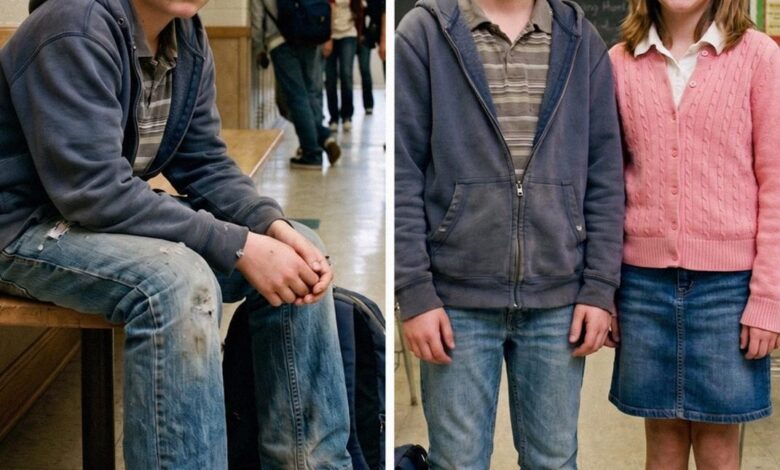
Just twenty four hours earlier, I had discovered the shattered remains of her ceramic piggy bank on her bedroom floor. When I questioned her, she had looked at me with a mix of defiance and shame, admitting she had spent every cent she had saved over the last few months—birthday money, chore earnings, and even her lunch allowance. She had seen a new boy in her class, Caleb, trying to keep his soles attached to his shoes with layers of duct tape. Emma hadn’t asked me for help because she knew things were tight for us, too. Instead, she had quietly shouldered the burden of his dignity, purchasing a brand new pair of sneakers and giving them to him in secret. I had been overwhelmed with pride, seeing in her the same selfless spirit her father, Joe, had possessed before his world—and his heart—collapsed under the weight of a public scandal.

Three years ago, my husband Joe had died of a heart attack following the spectacular failure of his investment firm. The media had painted him as a villain, a corrupt businessman who had gambled away the life savings of hundreds of families. The whispers followed us everywhere. Even after he was gone, the community treated his death as a “convenient” escape from justice. His former partner, Daniel, had fanned those flames, giving interviews where he spoke about Joe’s “guilt” as if it were a proven fact. I had spent three years trying to rebuild a life from those ashes, protecting Emma from the headlines and the vitriol. Now, standing in front of the principal’s office, I feared that the past had finally caught up with my daughter.

When I pushed open the heavy wooden door to the office, the air left my lungs. Sitting in the chair opposite the principal was a man I hadn’t seen since the funeral, though his face had haunted my nightmares for a thousand nights. It was Daniel. He looked aged, his sharp features softened by a weariness that made him look brittle, but it was unmistakably him. My first instinct was to scream, to demand why he was anywhere near my child. I assumed he was there to accuse Emma of something, or perhaps to reignite the old feud that had buried my husband. But as I sank into a chair, my knees giving out, Daniel began to speak, and the world I thought I knew started to tilt on its axis.

Daniel revealed that Caleb, the boy Emma had helped, was his son. After the business collapsed, Daniel had lost nearly everything, moving to our district to start over in the shadows. But the real revelation was much darker. He admitted that Joe hadn’t been the one who made the illegal trades that ruined the firm. It had been Daniel. Joe had discovered the truth too late, and when the walls started closing in, Joe had made a choice that defied logic: he took the blame. He believed that because Daniel had the Ivy League pedigree and the connections, Daniel was the only one who could eventually fix the mess and repay the investors. Joe had martyred his reputation and his life to protect a friend who had sat in silence while Joe was dragged through the mud.

The fury that rose in me was cold and paralyzing. For three years, I had lived as the widow of a thief. Emma had grown up believing her father was a failure. And all while Daniel had watched us struggle, knowing the truth. He explained that when Caleb came home with the shoes Emma had bought him, and he realized who the girl was, the weight of his cowardice finally became too much to bear. He saw in my twelve-year-old daughter a level of courage he had lacked for his entire adult life. She had seen a person in need and acted, while he had seen a person in pain and looked away.

The principal called Emma into the room, and the moment she saw me, she burst into tears, asking if she had done something wrong. I pulled her into a fierce embrace, burying my face in her hair, and told her that she was the best of us. I looked at Daniel, who was watching his own son cowering in the hallway, and told him that he needed to make it right. He promised he would. He promised a public confession, a clearing of Joe’s name, and a full accounting of the firm’s final days.

A week later, I watched on the evening news as Daniel stood before a bank of microphones and told the world what I had finally learned in that cramped school office. He told the truth about Joe’s sacrifice and his own greed. The headlines changed overnight. The “corrupt businessman” was suddenly a “tragic hero.” While the public’s memory is short and the money will never return, the stain on my husband’s legacy was finally washed away.

That night, I sat at the kitchen table with Emma, looking at an old photo of Joe. For the first time since he died, the image didn’t bring a sharp pang of shame or the heavy burden of a lie. I saw a man who loved his friends too much, and I saw the father of a girl who was exactly like him. Emma had spent her life savings on a pair of shoes, but in doing so, she had inadvertently bought back her father’s honor. We often think that we are the ones teaching our children about the world, but as I tucked her in that night, I realized that Emma had taught me the most important lesson of all: that even the smallest act of kindness has the power to shatter the strongest chains of the past. Truth is a heavy thing to carry, but thanks to a twelve-year-old girl and a pair of sneakers, we were finally walking in the light.

My Ex-Husband Left Me at the Hospital the Day Our Son Was Born – 25 Years Later, He Couldn’t Believe His Eyes

by

He didn’t slam the door when he left. That would have meant something—anger, regret, anything human enough to fight against. Instead, Warren gave me a single glance, one quiet sentence, and a silence that cut deeper than anything loud ever could.

I was still in a hospital bed when he decided our son’s life wasn’t the one he wanted.

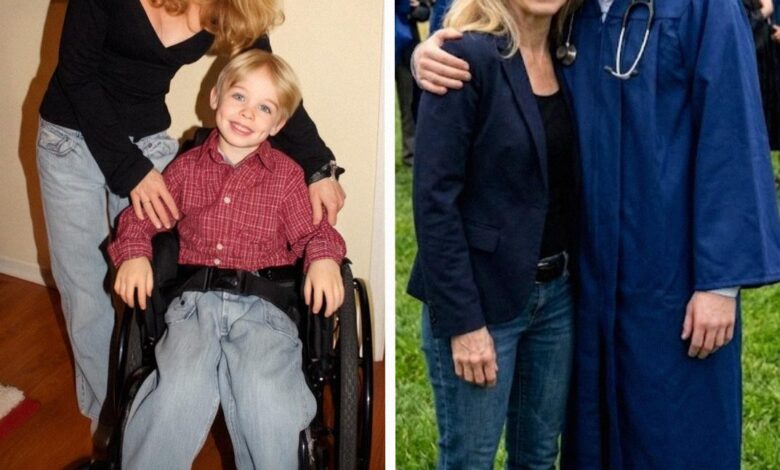
Our baby—Henry—was less than three hours old. His fingers were curled into the fabric of my gown, his breathing soft and uneven against my chest. The neurologist had spoken gently, carefully, explaining what we didn’t yet fully understand—motor impairment, uncertainty, therapy, time.

I remember nodding like she was giving directions to a grocery store.

And then I remember Warren reaching for his keys.

At first, I thought he just needed air. That was who he had always been—someone who stepped away before things became too heavy. But when I asked him for something as simple as a glass of water, he didn’t move.

He looked at our son like he was evaluating damage.

“I’m not doing this,” he said.

That was it. No anger. No panic. Just refusal.

He walked out of that room like he was leaving an appointment that had run longer than expected. And just like that, my life divided into before and after.

I looked down at Henry—so small, so unaware—and whispered the only truth I had left.

“It’s just you and me now.”

And somehow, even then, he looked like he already understood.

The years that followed weren’t inspiring. They weren’t the kind people turn into speeches or motivational quotes. They were messy, expensive, exhausting.

I learned how to stretch muscles while my hands trembled from exhaustion. I learned how to argue with insurance companies and how to smile at strangers who spoke to me like I had already lost something beyond repair.

At church, people lowered their voices when they spoke to me, like grief was contagious.

At school, they suggested Henry might be “more comfortable” somewhere less demanding.

Henry, even as a child, didn’t tolerate that kind of thinking.

“Do you mean physically,” he asked once, sitting across from an administrator who thought she was being kind, “or because you think I’m stupid?”

I had to bite my lip to keep from smiling.

He had my stubbornness. My refusal to shrink.

And over time, that refusal became strength.

By the time he was a teenager, Henry didn’t just understand his condition—he understood the system around it. He read medical journals at the kitchen table. He corrected doctors who spoke about him like he wasn’t in the room.

“I want to be the person who talks to the patient,” he told me once. “Not about them.”

That was the moment I knew he would build something bigger than the limits people had tried to place on him.

When he got into medical school, I thought the hardest part of our story was finally behind us.

I was wrong.

Because success has a way of calling people back who walked away when things were difficult.

Twenty-five years after he left, Warren reached out.

Not when Henry needed surgeries. Not when he couldn’t sleep from pain. Not when we struggled to pay bills.

Only now—when the story looked impressive from the outside.

He said he was proud.

He asked to come to graduation.

I said no.

Henry said yes.

I didn’t understand that decision until the night it all unfolded.

The room was filled with families—flowers, cameras, pride. I kept smoothing my dress, trying to quiet the nerves I couldn’t explain.

And then Warren walked in.

Older, heavier, polished—but unmistakably the same man who had walked out of a hospital room without looking back.

He approached us like he belonged.

And then he looked at Henry.

Not at his face. Not at the man he had become.

At his legs.

“You’ve done well for yourself,” he said. “No wheelchair. No cane.”

Henry didn’t react.

He just said, “Is that so?”

Minutes later, he stood at the podium.

And everything changed.

“People like stories like this,” he began. “They see the white coat and assume this is about perseverance. Mine.”

There were a few polite laughs.

Then he found me in the crowd.

“But if I’m standing here tonight, it’s not because I was born unusually strong. It’s because my mother was.”

The room went completely still.

He didn’t rush. He didn’t soften it.

“When I was born, a doctor told my parents my life would be harder than expected. My father left that day.”

Somewhere behind me, someone gasped.

“My mother stayed.”

That was all he needed to say.

Not dramatic. Not loud.

Just true.

“She carried me into every room my father was too weak to enter. So no—this isn’t a proud moment for both my parents. It belongs to the woman who never missed a hard day.”

And then, softer—only for me:

“Everything good in me learned your name first.”

I didn’t see Warren leave.

I didn’t care.

For twenty-five years, I had carried the weight of being the only one who stayed.

And in one moment, in front of a room full of strangers, my son gave that truth a voice I never could.

Not as revenge.

Not as anger.

But as something much harder to deny.

Recognition.

Afterward, Warren tried to speak.

“You invited me here for that?” he asked Henry.

Henry didn’t raise his voice.

“I didn’t embarrass you,” he said. “I told the truth.”

And that was the difference between us.

Warren had always chosen what was easy.

Henry chose what was real.

That night, as we drove home, I realized something I hadn’t fully understood all those years.

I thought I had been raising my son alone.

But I wasn’t.

Every hard day, every fight, every moment I refused to give up—

he was learning.

Watching.

Becoming.

And in the end, he didn’t just become a doctor.

He became the kind of man his father never had the courage to be.

I Supported My Parents For Fifteen Years And Lost Everything But When I Overheard Their Cruel Secrets During Christmas Dinner I Finally Reclaimed My Life

by


The drive from my parents’ house back to Boston was a blur of white static and blinding snow, but the storm outside was nothing compared to the wreckage of my own heart. I was thirty-eight years old, and for fifteen years, my life had been a performance of daughterly devotion that had slowly, systematically, bled me dry. I had a migraine throbbing behind my eyes, the kind that makes the world feel sharp and unforgiving, but the clarity it brought was the first honest thing I had felt in over a decade. Only hours earlier, I had been carrying a tray of dessert toward the dining room when I heard my mother’s voice, casual and sharp, cutting through the festive hum. She was talking to my aunt, laughing off the latest four-thousand-dollar transfer I had sent. She doesn’t deserve a thank you, my mother had said. She owes us—we fed her for eighteen years.

I stood frozen in the hallway, the weight of the silver tray feeling like lead in my hands. In that single, devastating sentence, fifteen years of sacrifice were reclassified from a gift of love to a debt of existence. I had started helping them when I was twenty-three, a young woman just beginning to find her footing in the world. My father had been injured, and my mother had sat me down, her face wet with tears, telling me they were weeks away from losing the family home. What was supposed to be a temporary bridge became a permanent lifestyle. I had paid their mortgage, settled their medical bills, funded home renovations, and covered “emergencies” that eventually turned into luxury vacations and country club memberships. I had become their personal ATM, fueled by a deep, misplaced sense of guilt that I could never do enough to repay the gift of my upbringing.

That night, lying in my childhood guest room under a quilt my mother had made, I didn’t cry. Instead, I reached for my phone, logged into my bank portal, and canceled the recurring transfer for January. With a final, shaking breath, I shut down the joint account entirely. The silence that followed was the loudest thing I had ever heard.

When I finally reached my apartment in Boston, I requested a full audit from my financial advisor. I needed to see the damage in black and white. When the files arrived, I sat at my kitchen table and stared at the numbers until they blurred. Over fifteen years, I had sent them $860,000. It was a staggering, sickening sum. I hadn’t just helped them survive; I had funded a life for them that I couldn’t even afford for myself. The irony was a bitter pill to swallow. Months earlier, I had lost my high-paying corporate job in a round of layoffs. I hadn’t told them because I couldn’t bear the thought of being the daughter who let her parents struggle. To keep the money flowing, I had drained my retirement accounts, sold my car, and moved out of my beautiful condo into a cramped, damp basement studio. I was working nights at a hotel front desk and freelancing eighteen hours a day just to ensure their SUV payment was on time. And through it all, they had never once asked if I was okay.

The fallout was instantaneous. When the January transfer failed to hit my father’s account, my phone didn’t ring with a “Happy New Year” or a “How are you?” It lit up with demands. The texts were cold, accusing me of bank errors and negligence. When I finally answered and told them the truth—that the money was gone and it wasn’t coming back—they pivoted to rage. They accused me of abandoning them in their old age, calling me selfish and ungrateful. I stayed calm, my voice a flat line of exhaustion. I didn’t abandon you, I told them. I finally stopped abandoning myself.

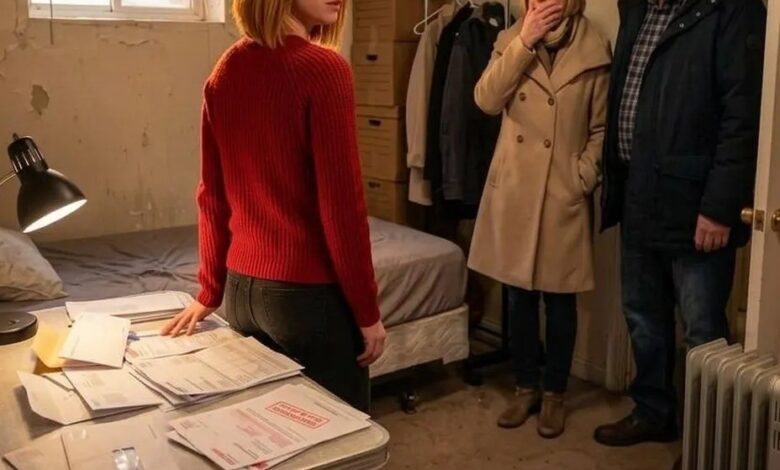
I emailed them every bank statement, every tax record, and every credit card bill I had paid on their behalf. I invited them to see me if they wanted to discuss the “debt” my mother claimed I owed. On New Year’s Eve, I heard the heavy knock on my basement door. They arrived expecting a confrontation in a home that matched the “successful” image they had of me. Instead, they stepped into a room filled with cardboard boxes, a single twin mattress on the floor, and a daughter who looked ten years older than her age. My mother’s eyes darted around the peeling wallpaper and the lack of furniture. My father stood by the door, his hands trembling. The silence was heavy with the smell of damp concrete and the truth.

I laid it all out on a folding card table. I showed them my empty retirement balance. I showed them the debt I had incurred to keep their lights on while they were buying new furniture and going on cruises. I told them that while they were enjoying a paid-off home and a comfortable retirement, I had almost nothing left but the clothes on my back and a mountain of stress. For the first time in my life, my parents had no defense. There were no tears from my mother this time, no manipulative guilt trips. My father sat on a folding chair and stared at the total figure—$860,000—until he quietly whispered that they truly hadn’t realized the cost. They had seen the money as a surplus I had, not as the very marrow of my bones.

They left that night, and the air in my tiny apartment finally felt breathable. In the weeks that followed, the dynamic shifted in a way I never thought possible. My father texted me to say they were selling the luxury SUV and cutting their expenses to the bone. He didn’t ask for money; he asked if I needed help moving into a better place. Months later, a letter arrived from my mother. It was a genuine apology, the first one I had ever received that didn’t come with a hidden request or an expectation attached. She admitted she had been wrong to view a child’s love as a transaction.

But the most important realization didn’t come from their apology. It came on that first night after they left my basement apartment, when I sat in the quiet of my humble space and realized that for the first time since I was twenty-three, I didn’t owe anyone anything. I was broke, I was starting over, and I was sleeping on a floor, but my life finally belonged to me. The debt had been paid in full, not with money, but with the courage to finally say no. I was no longer the daughter who was “repaying” her existence; I was a woman who was finally free to live it.

Bert and Edna, known for their warm humor and decades of shared memories, experience an unexpected Sunday moment that brings even more joy to their long marriage. Their lighthearted surprise becomes another cherished story in their lifetime of laughter together.

by


Once Bert senses that Edna genuinely wants the conversation, he decides to reveal a long-held dream of his: trying skydiving. Edna is stunned enough to nearly spill her tea. She teases him mercilessly, reminding him that he almost fainted tying his shoe just a month prior. But beneath the teasing, she is clearly amused and intrigued by his adventurous spirit. Soon they are laughing together as they imagine Bert descending from the sky, perhaps drifting off-course and landing in the neighbor’s garden. The playful banter lifts their spirits, reminding them of the exciting dreams and silly possibilities they used to share when they were younger.

When it is Edna’s turn, she hesitates just long enough to create suspense. Then, with the same mischievous sparkle she had as a young woman, she reveals that she has been keeping a few small secrets over the years—nothing serious, just the kind of playful mischief that becomes funnier as time passes. She admits that she was responsible for Bert’s recliner leaning to the left for two decades and confesses that she once rigged the remote so it automatically switched to holiday movie channels. Bert is momentarily shocked, then erupts in laughter so hearty that the porch swing groans beneath them. Her confessions are not revelations of wrongdoing but rather reminders of the shared humor and inside jokes that have colored their marriage.

These small secrets evoke memories of the ways they have playfully shaped each other’s lives throughout the years. Instead of frustrating him, Edna’s revelations spark joy in Bert, reminding him of all the delightful quirks that have made their marriage rich and full of character. They realize that these funny little stories—some known, some kept quiet—have become precious threads in the tapestry of their shared life. The years have been filled not only with milestones but with countless small moments that built their bond gradually, lovingly, and sometimes mischievously.

Eventually, the laughter fades into a warm silence as the air grows cooler and the sun dips lower. The couple continues to sit together, still holding hands, the porch around them filled with the ease of long familiarity. It is in this tender quiet that Bert decides to share his own confession—not a prank or a joke, but something heartfelt. He turns to Edna and tells her that after all the years they have spent together, his greatest adventure has always been her. The sincerity of his words carries more weight than any bucket-list dream because it speaks to the true foundation of their lives: the love they have built and sustained for more than half a century.

Edna’s smile in response mirrors the warmth of the sunset. In that moment, the two of them come to an unspoken realization. Their bucket lists, whether ever written down or spoken aloud, have already been quietly filled over the years. Not with extreme adventures or grand accomplishments, but with companionship, shared laughter, simple joys, and enduring affection. Their lives have been shaped by the small and steady moments—comforting routines, playful jokes, mutual support—that have added up to something far more meaningful than any single daring experience could ever offer. Through love, humor, and decades of partnership, they have already lived the adventures that mattered most.

I thought I’d found an abandoned puppy—but it wasn’t a puppy at all. A year later, I was shocked by what it had grown into... Details in the first comment👇

by


I Thought It Was a Puppy

At first, nothing seemed strange. It slept constantly, made soft squeaking sounds, and drank formula from a dropper. Friends who saw photos agreed it looked like some kind of newborn dog, maybe mixed with something unusual. Its fur was dark and slick, its movements awkward and clumsy. I named it Shadow and built my days around feedings, warmth, and quiet reassurance. The bond formed fast, the kind that sneaks up on you when you’re protecting something that depends on you to survive.

But as weeks passed, little details stopped adding up. Shadow didn’t bark. Its paws weren’t shaped like a dog’s. The way it moved was different, more fluid, almost deliberate. By three months, it loved water in a way no puppy I’d ever known did, splashing endlessly and refusing to leave the tub. Its body stretched longer, sleeker, and its eyes grew sharper, more alert. People began asking questions I couldn’t answer, and for the first time, doubt crept in.

By six months, the truth was impossible to ignore. Shadow wasn’t a puppy at all. The animal in my home was a young otter, rescued far from where it should have been, likely separated from its mother by flooding. The realization hit me like ice water. I had unknowingly been raising a wild animal, one far more intelligent and powerful than I’d ever imagined. The tiny creature I once cradled had grown into something strong, curious, and undeniably wild.

Letting go was the hardest part. Wildlife experts explained that while Shadow trusted me, it could never truly belong in a human home. Watching it leave, knowing I’d done the right thing, broke my heart in a way I still struggle to explain. Yet there was relief too, seeing it glide confidently into water where it belonged, no longer fragile, no longer lost. The shock wasn’t just what it had grown into, but what it had taught me.

Sometimes I think about that first night, about how easily we label what we don’t understand. I thought I’d found an abandoned puppy, but what I really found was a reminder of how wild the world still is, hiding in plain sight. Shadow grew into something extraordinary, and for a brief moment in time, our lives crossed in a way I’ll never forget.

Top Ad 728x90