My Daughter Banned Me From Her School Because Of My Face But A Stranger Revealed The Heartbreaking Truth I Had Hidden For 20 Years
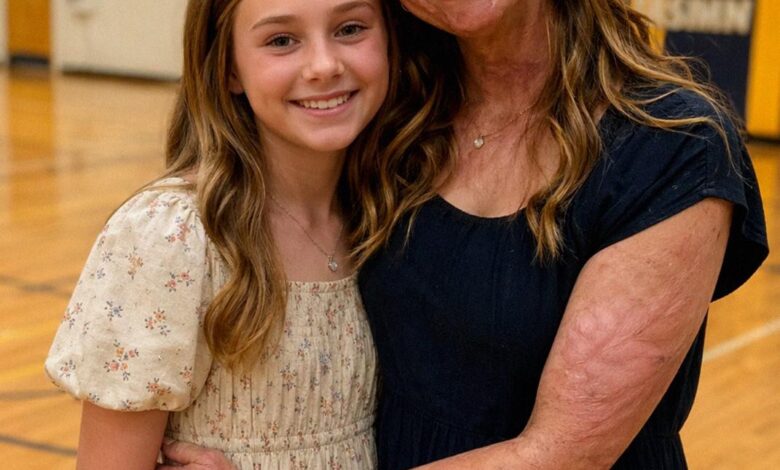
Every morning, I confront a reflection that most people would turn away from. The left side of my face is a roadmap of a tragedy that struck two decades ago. Thick, ridged scars trace a path from my temple, across my cheek, and down into the hollow of my neck. Makeup can soften the edges, but it can never erase the history written in my skin. For twenty years, I have navigated a world of stares—some pitying, some curious, and some cruelly mocking. I had grown accustomed to the weight of those looks, but I never expected that my own daughter would be the one to buckle under them.
I have raised Clara alone since my husband passed away when she was just three. Our life was small but full, anchored by my mother, Rose, who lived next door. Clara was always a tender child, the kind who would reach out with small, sticky fingers to trace the lines on my jaw and ask if it hurt. I always told her no, and for a long time, that was enough. But as she entered the fifth grade, the innocence of childhood began to sour into the self-consciousness of adolescence.
The shift happened on a Tuesday. I had decided to pick Clara up from school early. As I waited by the curb, I saw her standing with a group of classmates. One boy pointed toward my car and whispered something behind his hand, prompting a chorus of snickering. Clara’s reaction was instantaneous; her shoulders slumped, her head dropped, and she climbed into the car without meeting my eyes. The silence in the vehicle was heavy, vibrating with an unspoken shame that made my chest ache.
Finally, she whispered the words that felt like a physical blow: she asked me to stop coming to her school. Through tears, she explained that Mother’s Day was approaching, and her class was preparing a presentation where each student would bring their mother onstage. The “monster mom” jokes had already started. She had been called a “monster’s baby,” and cruel drawings had been circulated behind the teacher’s back. Clara wasn’t being mean; she was simply a little girl drowning in a sea of peer-pressured cruelty. She wanted Grandma to go in my place because no one laughed at Grandma.
That night, I sat in the quiet of my kitchen, my fingers tracing the uneven ridges of my skin. I remembered the heat, the smoke, and the screams of that night twenty years ago. I had never told Clara the full story because I didn’t want her childhood to be colored by my trauma. I wanted to be just “Mom,” not a survivor, not a victim, and certainly not a hero. But as I looked at her empty chair, I realized that my silence was allowing the world to define me in the worst way possible.
The next morning, I dressed in a navy gown that felt like a suit of armor. I curled my hair to frame the scars rather than hide them. My mother stood in the doorway, her eyes fierce with pride. She told me to go and make them uncomfortable, and for the first time in days, I felt a spark of resolve.
When we arrived at the school, Clara was a ghost of herself. She gripped the door handle as if she might bolt at any second. I held her hand, leading her into the crowded auditorium where the air was thick with the scent of floor wax and perfume. We took our seats, and I felt the familiar prickle of stares. The presentation began, and one by one, mothers and children walked onstage to share stories of lasagna and bedtime prayers. Each round of applause felt like a countdown to our own public execution.
When Clara’s name was called, she froze. I stood up, offering my hand, and we walked toward the stage. Halfway down the aisle, a crumpled ball of paper struck my shoulder. I picked it up and smoothed it out to find a grotesque drawing of a horned creature with scarred cheeks. A boy’s voice hissed from the back: “There’s the monster’s daughter!” The room didn’t erupt in laughter this time; it fell into a jagged, uncomfortable silence.
I took the microphone, my heart hammering against my ribs. I began to speak, not to the crowd, but to my daughter. I told the room that these scars were not the worst thing to happen to me—the worst thing was seeing my child ashamed of her mother. I began to recount the night of the fire, explaining how I had run back into a burning apartment building as a teenager to save three children. But before I could finish the sentence, the heavy doors at the back of the auditorium swung open with a bang.
A man stepped into the light, breathing as if he had run a marathon. It was Scott, the school’s music teacher. He marched down the aisle, his eyes locked on the stage. He took the microphone and told the audience that they didn’t know the whole truth. He looked at Clara and revealed that twenty years ago, Emily hadn’t just saved three random children. She had realized one was still missing after the first trip. Despite the building collapsing and firefighters shouting for her to stay back, she had plunged back into the inferno one last time.
“She found me,” Scott said, his voice thick with emotion. “I was ten years old, huddled under a table, and she carried me out through the flames. She didn’t lose her face saving a group of strangers; she lost it saving me.” He explained that my only request to his parents back then was that they never tell the story. I hadn’t wanted a child to grow up carrying the guilt of my injuries.
The atmosphere in the room shifted violently. The mockery vanished, replaced by a weight of realization that was almost palpable. The boy who had thrown the paper lowered his head, his face burning with a different kind of shame. Clara turned to me, her eyes wide, seeing me for the first time not as a source of embarrassment, but as the woman who had sacrificed her beauty to give a stranger a lifetime.
“I was ashamed,” she whispered as I knelt before her on the stage. “And I let them laugh.” I pulled her into a hug, telling her that she was just a child who had been hurt, and that there was nothing to forgive. The auditorium erupted into applause—not the polite clapping from before, but a thunderous, standing ovation that seemed to shake the very walls.
The ride home was different. The windows were down, and the air felt clean. Clara asked why I had kept the secret for so long, and I told her the truth: I didn’t want the fire to be my entire identity. I wanted to be her mother, not a tragedy. But I realize now that the truth doesn’t make me tragic; it makes me whole. My scars are no longer a mark of what I lost, but a testament to what I was willing to give. As we walked into our house together, Clara didn’t look at the floor. She looked at me, and for the first time in twenty years, I didn’t feel the need to look away from the mirror.


0 comments:
Post a Comment