They Mocked Me at My Own Restaurant Until One Moment Turned the Entire Room Silent
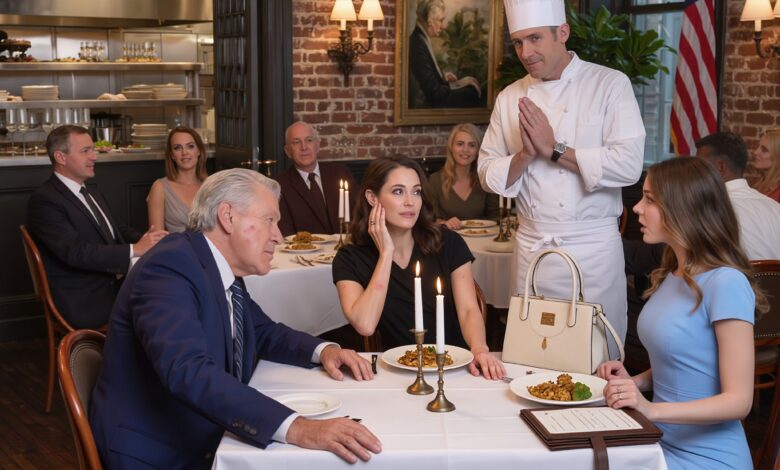
There is something people never warn you about when you build something from nothing. They talk about money, about risk, about long hours and sleepless nights. But they never mention the part where the hardest thing isn’t the work itself. It’s deciding who gets to stand inside what you’ve created and who doesn’t.
I learned that too late.
Years ago, when my business partner Nina and I stood inside an empty warehouse in Charleston with barely enough money to keep the lights on, she told me something I didn’t fully understand at the time. She said the most important decision we would ever make wasn’t about the menu or the design or the pricing. It was about people. About who we let into our space.
Back then, I thought she meant staff. Hiring. Standards. Professional boundaries.
She wasn’t talking about any of that.
She was talking about my family.
Three years later, I stood in the dining room of the restaurant we built, watching everything I had worked for unfold around me in perfect rhythm. Tables were set with precision. Candles flickered softly. The air carried the scent of butter, garlic, and something deeper that only comes from years of refinement and repetition. It was full, alive, exactly the way I had imagined it in the worst moments when I wasn’t sure we would make it.
And sitting at one of those tables was the last group of people I ever expected to see there.
My family.
They hadn’t come because of me. They didn’t even know I owned the place. They had booked it because it was trending, because it showed up on some list of must try restaurants, because it looked impressive enough for a birthday dinner that cost more than they would ever admit out loud.
When I saw their name on the reservation earlier that evening, my body reacted before my mind could catch up. It was subtle, but real. That quiet tension that builds when something unresolved walks back into your life without asking permission.
I should have stayed in the kitchen.
That was the right move. The obvious move. Let them eat, let them leave, let it remain a coincidence.
But I’ve never been good at staying away from things that hurt me.
So I changed out of my chef’s coat, slipped into a dress I kept for situations exactly like this, and walked into my own dining room like I was just another guest.
They were exactly the same.
My father sat at the head of the table, posture firm, expression set, the kind of presence that expects attention without asking for it. My sister Sutton sat beside him, glowing in the effortless way that comes from never having to fight for anything. She was the center of the room, as always, and everyone else revolved around her without question.
There was a seat for me.
At the end of the table.
There was always a seat at the end.
The first part of the evening went the way it always did. Polite conversation, surface level warmth, the illusion of connection. Stories about Sutton’s job, her plans, her life. Everything framed as achievement, everything met with approval. I listened, nodded, smiled when expected.
I’ve been playing that role my entire life.
Then the food arrived.
And that’s when something shifted.
Sutton had ordered the signature dish. The one that built our reputation. The one critics wrote about, the one people came back for again and again.
My mother’s recipe.
Refined, elevated, but still rooted in the memory of standing beside her in a small kitchen years ago, learning something that felt like more than just cooking. It was one of the few things I carried with me when everything else fell apart.
Sutton took a bite and reacted exactly the way every guest did.
A pause. A moment. Then praise.
She called it incredible.
My father tried it too. He nodded once, the same way he always had, as if approval was something he handed out sparingly and without emotion.
Not bad, he said.
Not bad.
It should have been enough. It should have been satisfying in some distant way. But it wasn’t. Because they had no idea what they were eating, no idea what it meant, no idea whose hands had brought it to life.
And then someone asked me a simple question.
What do you do
Before I could answer, Sutton stepped in.
She said I cooked somewhere downtown. Casual. Dismissive. Like it was a hobby. Like it didn’t matter.
The food thing, she called it.
That phrase had followed me for years. Through every job, every struggle, every moment where I chose something they never respected. Hearing it again, in that room, surrounded by everything I had built, hit differently.
But I let it go.
I always let it go.
The evening continued. Gifts were exchanged. Expensive ones, carefully chosen to impress, to reinforce the dynamic that had always existed between us.
When it was my turn, I gave Sutton something simple.
A journal. Leather bound. Inside, I had written our mother’s recipe by hand, carefully, intentionally, as a way of preserving something that mattered.
She barely looked at it.
Said she didn’t cook.
Set it aside like it was nothing.
That should have been the end of it.
But then someone at the table praised the dish again, this time with real enthusiasm, unaware of what they were touching, unaware of what it meant.
And something in me slipped.
I tried to explain. Softly. Carefully.
Just enough to acknowledge where it came from.
That was all it took.
Sutton snapped.
Accused me of making everything about myself, of ruining her night, of turning a simple dinner into something uncomfortable. Her voice rose, drawing attention from nearby tables. The room shifted, the energy changing as people sensed something was wrong.
My father told me to stop.
Not loudly. Not dramatically. But in a way that carried finality.
Drop it, he said.
And in that moment, I understood something I had been avoiding for years.
No matter what I built, no matter what I achieved, I would always be the same person to them. The one at the end of the table. The one who needed to stay quiet to keep the peace.
But this wasn’t their table.
This wasn’t their space.
Before I could respond, before anything else could escalate, something unexpected happened.
The head chef walked out of the kitchen.
Not casually. Not by accident.
He came straight toward the table.
And then, in front of everyone, he stopped beside me.
And addressed me by name.
Respectfully. Publicly.
Asking if I wanted him to handle the situation.
The silence that followed was different from anything earlier in the night.
It wasn’t tension.
It was realization.
For the first time, my family saw me the way everyone else in that room already did. Not as an afterthought. Not as someone to dismiss. But as the person who owned everything around them.
The shift was immediate.
Subtle, but undeniable.
And in that moment, I didn’t feel the need to explain anything.
Because the truth had already spoken for itself.


0 comments:
Post a Comment