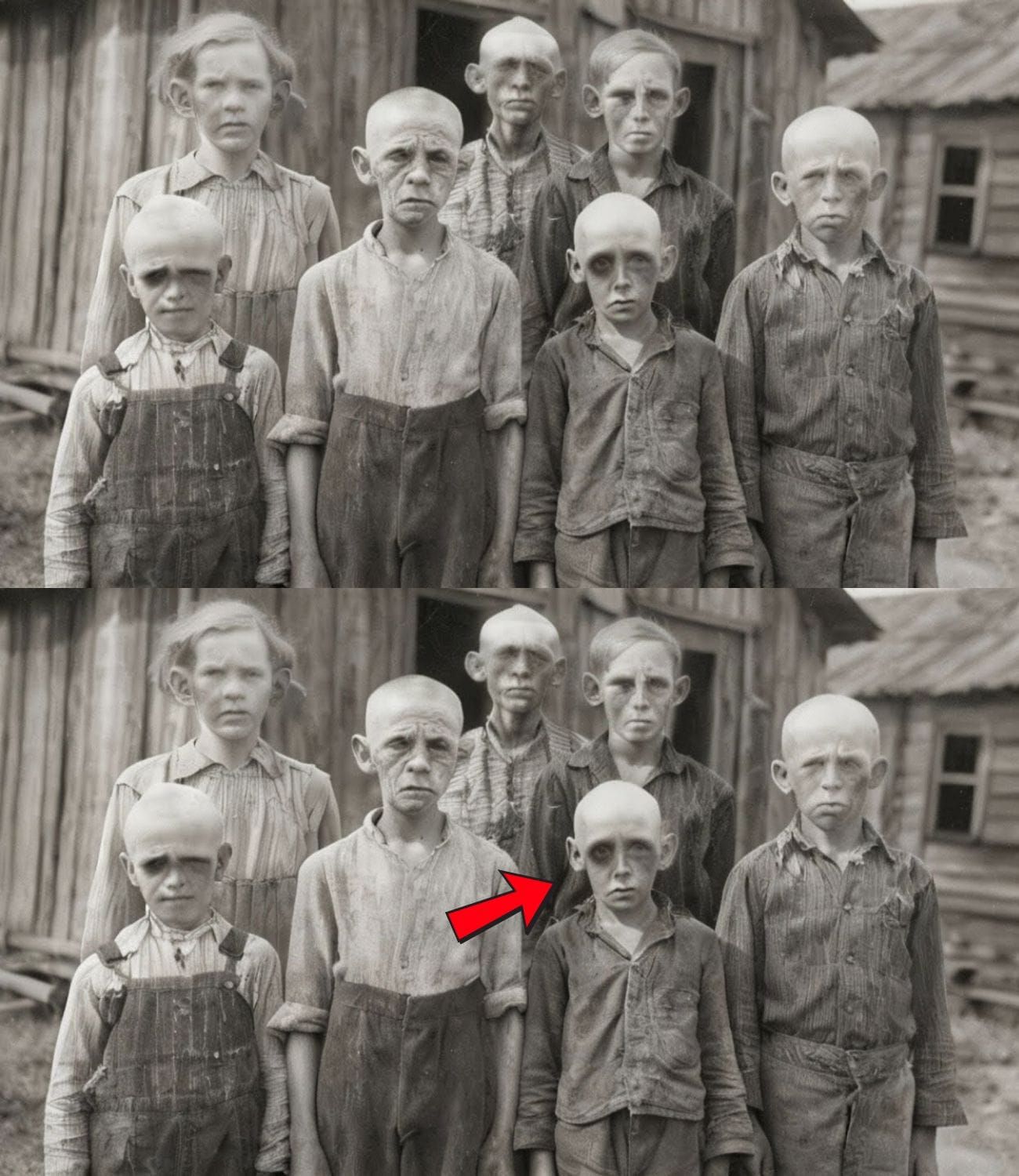
The staff didn’t know if this was progress or something worse. Dr. Ashford’s notes warned that separation resulted in death. But this wasn’t a forced separation; it was a choice, and it raised a question no one wanted to ask. If the children chose to individuate, what did that mean for who they had been before? In March 1976, one of the older girls, about 23, though she looked even younger, asked a nurse for her name. Not the nurse’s, but her own. It was the first time a girl had shown any interest in her individual identity. The surprised nurse checked the admission records. There were no names. The children were listed by number, from Subject 1 to Subject 11. The girl looked at the nurse for a long moment and then walked away. That evening, she spoke English for the first time. She said, “We’ve forgotten.” The nurse asked her what she meant. The girl looked at her with her dark, steady eyes and said, “We’ve forgotten how to be Dalhart.”
By 1978, the children had deteriorated. Not physically, but mentally. They began to show confusion, memory lapses, and what the staff described as an identity crisis. They forgot their own faces. One boy spent an entire day convinced he was one of the girls. Another claimed she had died years before and that the person who had replaced her was someone else. They stopped recognizing each other. The synchronicity that had once defined them was gone, replaced by chaos. Two of the children became violent, not with the staff, but with each other, as if trying to destroy something they could no longer control. They were sedated and separated into different rooms. Both died within 48 hours. The official cause of death was heart failure, but their hearts had been perfectly healthy the day before. It was as if their bodies had simply given up the moment they could no longer be who they had always been.
By 1980, only four of the original eleven children were still alive. The state decided to close Riverside Manor. The residence was too expensive.
Halloway asked her to clarify. She explained that the Dalhart children weren’t individuals, but extensions of the family. When they needed a child, the family performed a ritual. She didn’t describe it in detail, but she mentioned blood, earth, and what she called “the conversation,” and then a new child would appear, not born of a mother, not as children are normally born. They simply arrived fully formed, integrated into the family consciousness. She said the children shared a single consciousness, a collective mind that allowed them to function as a single organism distributed across multiple bodies. That’s why the separation killed them. It wasn’t trauma or attachment. It was a rupture, like the amputation of a limb. The body could survive, but not the limb. And when the family consciousness began to fragment in the 1970s, when the children began to develop individual identities, it was because the bloodline itself was dying. The rituals had ceased. The connection had been severed. And without it, the children were just bodies, empty shells trying to understand how to be human without ever having learned.
Sarah had told Halloway that she was the last, the final continuation of a line that had lasted for centuries. She said that sometimes she could still sense the others, even though they were dead: a deep presence in her mind, voices that weren’t voices. She said she had spent most of her life trying to silence them, trying simply to be Sarah, one person, simply human. But it never worked because she wasn’t human, not entirely. She was the last piece of something ancient, something that had remained hidden in the hills for generations, pretending to be a family when it was something else entirely. And now, with no way to continue, no way to perform the ancient rituals, no way to bring another generation into the world, she waited. She waited for the line to finally end. She waited for the last thread to break. She watched Halloway across the table.
Then, in 2023, a woman from Kentucky came forward claiming to be a distant relative of the Dalhart family. She said her grandmother was born in Hollow Ridge in 1938 and ran away from home as a teenager, abandoning her family and never speaking of them again. The woman said her grandmother died in 2021. But before she died, she revealed something to her. She told her that the Dalharts weren’t a family. They were the continuation of something older than families, something that didn’t reproduce or grow, but rather persisted. And she said that as long as the bloodline existed, it would never truly die. It would simply wait. It would wait for the right conditions. It would wait for the right land. It would wait for someone to remember the old ways.
Sarah Dalhart was supposed to be the last, the final link in a bloodline that stretched back centuries. But bloodlines aren’t bloodlines. They aren’t bound by genetics or birth. They’re patterns, instructions written into the world, waiting to be followed. And patterns don’t die. They repeat. They are resurrected. They find new bearers. The state sealed the files. The witnesses remained silent. The reporters moved on. But the land remembers. Hollow Ridge remembers. And somewhere in the land that has drunk the blood of generations, something is still waiting. It isn’t dead, it isn’t gone, it’s just waiting patiently. Because that’s what the Dalhart bloodline has always been: not human, not entirely, but something that learned to use humanity as a mask, generation after generation, until the mask became indistinguishable from the face beneath. And when you bury something like that, you don’t kill it. You just plant the seed deeper. The question isn’t whether it will return. The question is whether we will recognize it when it happens, or whether, like the staff at Riverside Manor, like the authorities in 1968, or like Eric Halloway standing on Sarah’s grave, we will simply choose to look away, to forget, to pretend that certain stories.


0 comments:
Post a Comment