Bbuding Recipes

  • Home
  • Recipes

Top Ad 728x90

Friday, May 8, 2026

Most Drivers Miss This Simple Button That Improves Visibility At Night


Most Drivers Miss This Simple Button That Improves Visibility At Night

The highway stretches dark ahead, and your headlights carve a tunnel through the night. A car pulls up behind with LED beams so bright they flood your rearview mirror with white light. The glare burns into your peripheral vision and makes the road ahead harder to see. Most drivers don’t know their rearview mirror has a built-in fix for headlight glare. Plenty of driving advice covers headlights and windshields, but the best tips for night visibility start right above your dashboard.
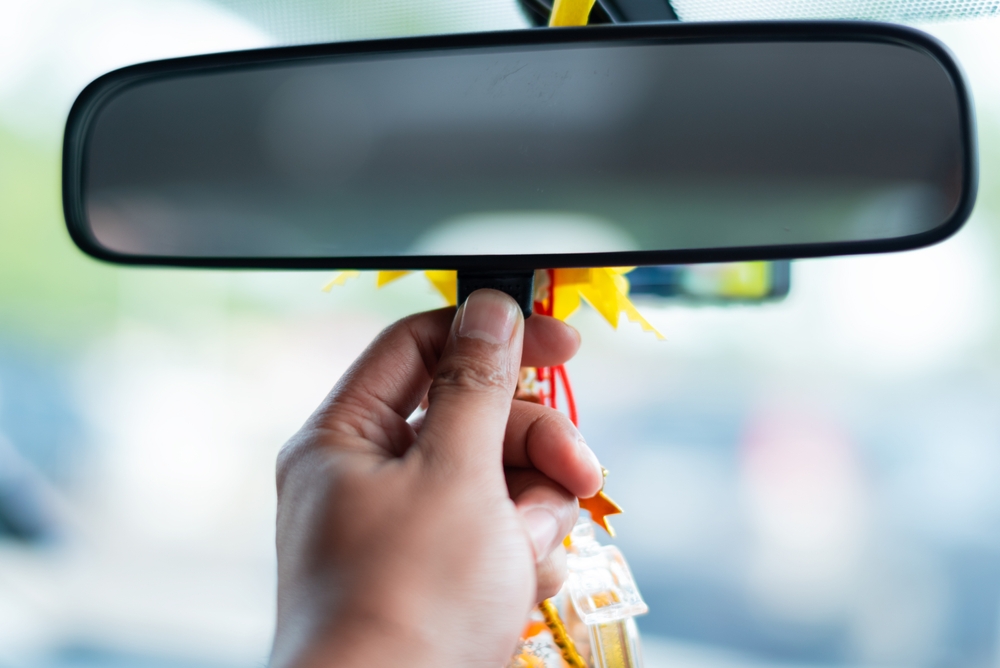
Man's hand presses adjusting rearview mirror dimming. Selective focus.
Flip the small tab under your rearview mirror to instantly dim glare from bright headlights.
Image credit: Shutterstock

Your rearview mirror has a small tab that dims glare instantly. The tab sits at the bottom center of the mirror, usually about an inch wide and sticking out half an inch from the housing. Flip it forward when bright LED beams flood your view, and the blinding light drops to something manageable.

How The Dimming Works

The tab changes the angle of your mirror when you flip it. Some tabs push and pull while others flip up and down, but all make a subtle click when moved. That click tells you the mirror has tilted to its night position. The change looks subtle if no bright lights are hitting the mirror, so test it with headlights behind you to see the difference clearly.

The view behind you should stay visible, but it looks much darker. This happens because rearview mirrors use wedge-shaped glass with a reflective coating on the back surface. In the day position, light bounces off that back surface to give you a bright, clear reflection. Flip to night position, and the mirror tilts so the reflection comes from the weaker front surface instead.

The mirror’s geometry controls which reflection reaches your eyes. The front surface reflects only 4% of incoming light, while the back surface reflects around 80%. This difference creates the dimming effect without batteries or sensors, which explains why the design has barely changed since manual day/night mirrors first appeared in the 1930s and became standard equipment by the early 1970s. 

Simple wedge shape and mechanical lever prove more reliable than many electronic alternatives because there are no batteries to die and no sensors to fail.

The dimmed view takes some getting used to because cars appear farther away than they actually are, but this tip makes sense for night driving when bright headlights can wipe out your vision for several seconds.

When to Switch Back at Night

Most drivers flip the tab once and forget it exists. Some leave it dimmed all day and ruin their visibility for no reason. Others never touch it and squint through glare. One simple driving tip when driving at night is to flip the tab based on what you see, not what time it is. Street lights and well-lit roads provide enough ambient light that dimming becomes unnecessary, so save it for dark country roads and highways where the contrast between darkness and bright headlights creates the worst glare.

Lane changes feel wrong at first because distances look off. The adjustment takes a few trips, but modern LED and HID headlights can be blinding for several seconds. The slight distortion beats losing vision when switching lanes.

The National Highway Traffic Safety Administration received over 4,000 public comments about headlight glare in 2001, more responses than any other safety concern that year. The problem hasn’t gone away. Headlights shifted from halogen to LED and HID technology, which made them brighter and more likely to cause glare. An online petition asking Congress to regulate these lights has collected over 50,000 signatures because more vehicles now use high-mounted lights that shine directly into rearview mirrors.

When Driving Dimmed Becomes Dangerous

The dimmed mirror helps on dark highways but fails in parking lots. Flip it back to day mode before backing up because the reduced brightness makes distances harder to judge. Shopping carts and concrete barriers can vanish entirely, so a routine backup turns risky.

Parallel parking demands the same precision. You need to see exactly where the curb sits and how close the car behind you is, but the dimmed reflection makes these judgments nearly impossible. Parking garages with their concrete pillars and tight spaces create the same problem, so flip the mirror back before you maneuver.

Don’t forget to switch back each morning. Driving with the dimmed mirror during daylight cuts your awareness of surrounding traffic, which makes lane changes riskier when you need clear views of cars behind you.

Electrochromic Mirrors Automate This

Flipping the tab forward at night and back each morning adds one more task to remember. Forget once while backing up, and you might hit a shopping cart that vanished in the dimmed reflection, so automatic mirrors handle the job for you.

Jacob Rabinov sits in his office before a wall of bookshelves in this 1950s black and white photograph. The inventor wears glasses and a dark suit with a light colored shirt. His photocell device automatically adjusted car mirrors to reduce headlight glare at night.
Jacob Rabinow’s 1950s invention used a photocell to automatically tilt and dim car mirrors in response to headlight glare. Image by: National Institute of Standards and Technology, via Wikimedia Commons

American inventor Jacob Rabinow developed the first light-sensitive automatic mechanism for car rearview mirrors in the 1950s, earning a patent reported in a 1961 New York Times article. The device used a photocell to detect glare from headlights and automatically dimmed the mirror by tilting it with motors. But mechanical systems wear out, which pushed later inventors toward electronic solutions.

Gentex Corporation solved this problem in 1986 with electrochromic dimming, which became the best solution for driving after dark because the car mirror settings adjusted smoothly without mechanical parts. The technology uses a gel layer sandwiched between two pieces of glass that darkens when voltage flows through it. This means the mirror dims silently and adjusts to any brightness level instead of just two fixed positions.

Sensors control when the gel darkens. A forward sensor measures ambient light while a rear sensor watches for headlight glare behind you. When the rear sensor spots a bright light, it sends a voltage to the gel layer. The gel darkens in proportion to how bright those headlights are, so the dimming adjusts continuously as cars get closer or farther away. The mirror clears back to normal when the lights disappear.

These systems became standard on many mid-range vehicles by the 2010s as production costs fell. Side mirrors often use the same technology, dimming all three together. The rearview mirror tells the side mirrors when and how much to dim.

How to Know If Yours Is Automatic

Look for a tab or lever at the bottom of the mirror. If you don’t see one, the mirror uses automatic dimming because manual mirrors always have that mechanical switch.

A driver's eyes reflected in a car's rearview mirror at dusk, with blurred city lights visible through the windshield. The mirror displays a small green indicator light for its auto-dimming feature.
A small LED on an automatic mirror glows to show the dimming system is active. Image by: Unsplash

Automatic mirrors have a small LED on the face that glows green or amber. The indicator shows the system has power, and it usually sits near the bottom edge of the glass. Some mirrors display AUTO when the feature runs.

Test the system by shining a flashlight at the mirror from behind your seat. The glass should darken gradually within a few seconds. If nothing happens, check the owner’s manual because some systems include an off switch or require activation through vehicle settings.

Most automatic systems let you adjust how aggressively they dim. Some vehicles bury this setting in the dashboard screen, while others put a button directly on the mirror. Adjusting the sensitivity ranks among the most useful night driving tips because factory settings don’t match every driver’s preference.

Older automatic mirrors sometimes fail when the gel degrades or sensors die. The mirror might stay dark permanently, ignore bright lights entirely, or dim inconsistently. Replacement costs depend on what else the mirror includes, so a basic auto-dimming mirror costs less than one with a compass display or garage door opener built in.

Buttons Instead of Tabs on Some Models

Some manufacturers add a motor to manual dimming controls. This design appears on certain European luxury brands like BMW and Mercedes, and some Lexus models. Press the button and the motor tilts the mirror between day and night positions. The button sits where a flip tab would normally be and makes a quiet whirring sound as the motor adjusts the angle. The change takes about a second. The button sometimes includes an LED that shows which mode is active.
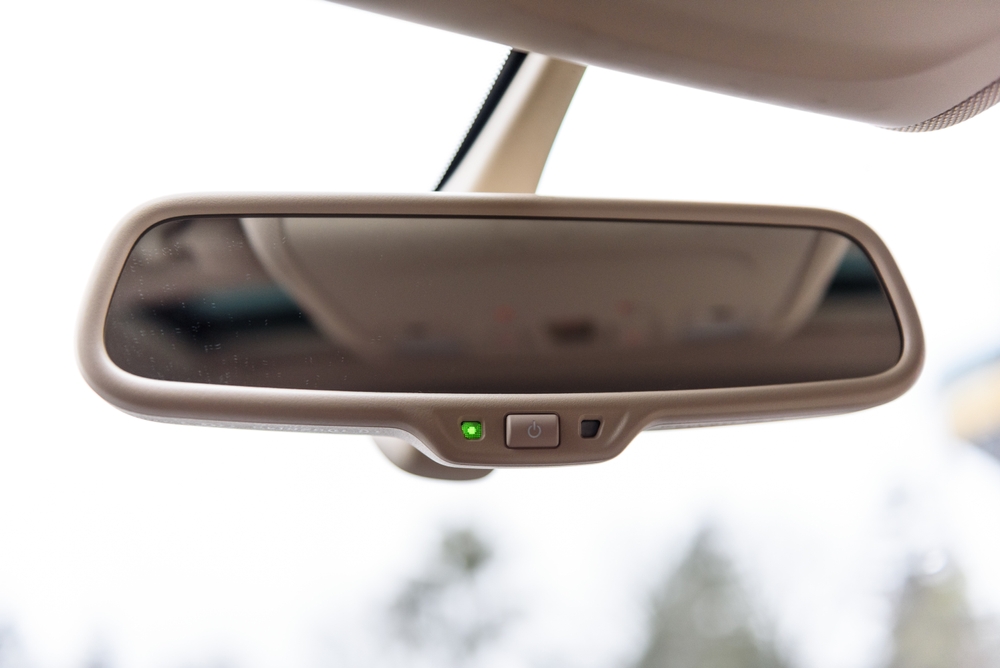
Car rearview mirror in automobile. Vehicle interior with rear view mirror and windshield - car salon concept. Auto dim button. Auto dimming button. Details interior closeup.
Press the dimming button in certain cars to let a small motor tilt the mirror between day and night modes. Image credit: Shutterstock

The motorized button tilts the mirror just like a flip tab does, but a motor handles the work instead of finger pressure. This means the driver still decides when glare becomes a problem and presses the button to dim. Automatic mirrors eliminate this decision because sensors detect the glare and dim on their own.


How Automatic Mirrors Came to Exist

Drivers had dealt with headlight glare for decades by flipping a manual tab that changed the mirror angle. The tab worked, but required the driver to notice the glare and take action every time bright lights appeared behind them. Gentex Corporation automated this process in 1982 by connecting light sensors to a small motor that tilted the mirror when glare appeared. These electromechanical mirrors became optional equipment in luxury cars by 1983.

The motor system solved the glare problem, but the mechanical parts made it expensive and prone to failure. Engineers kept searching for more reliable ways to help the public drive safely at night and avoid accidents.

A father and son team of chemists brought Gentex the answer. They had developed an electrochromic gel that darkens when electricity flows through it and clears when the current stops. Gentex spent years refining a way to sandwich a thin gel layer between two pieces of glass. Sensors mounted on the mirror housing could now trigger an electrical charge that darkened the gel instantly, with no moving parts.

The first electrochromic mirror appeared in the 1988 Lincoln Continental. Eight GM models added the feature in 1989, and the technology spread through the industry during the early 1990s. Donnelly Corporation developed similar technology and tried to compete. Gentex sued them for patent violations in 1990, starting a legal battle that lasted through the decade. Both companies survived and kept making mirrors, but Gentex maintained the dominant position.

The Design Flaw That Ruined Interiors

Success bred competition, but competition bred problems. Magna Donnelly manufactured most automatic mirrors between the late 1990s and mid-2000s with seal materials that couldn’t withstand years of exposure to the gel and temperature cycling. The seals eventually broke down, and where they broke determined how fast the gel escaped.

Top breaches took weeks before bubbles or dark spots appeared as air seeped through. Bottom breaches started dripping the same day because gravity pulled the gel straight down through the opening. Sometimes the dimming function quits before any visible damage shows, leaving the mirror stuck dark or unable to dim at all. Once the gel escaped, it ate through the plastic trim and paint. Some owners found it pouring onto their center console without warning.

BMW moved all mirror production to Gentex in 2007 after warranty claims stacked up. Other manufacturers followed because Gentex had fixed the seal problem with better materials and manufacturing processes. Gentex now supplies about 85% of automatic mirrors worldwide, so most cars built after 2010 avoid this failure.

Cars from those problem years still exist. Any mirror showing gel bubbles or dimming issues needs removal before the liquid escapes and damages interior parts that cost far more than the replacement mirror itself.

Newer Post Older Post

0 comments:

Post a Comment

Subscribe to: Post Comments (Atom)

Top Ad 728x90

Popular Posts

  • If your dog is sniffing your genital area, it means you have…See more
      If your dog is sniffing your genital area, it means you have…See more WHY DO DOGS SNIFF YOUR PRIVATE AREA? As an animal owner, it is your ...
  • If a woman has small breasts, it means that her part int...See more.
      Breast size can be influenced by hormonal health, particularly levels of estrogen, progesterone, and prolactin, which play key roles in br...
  • everyone to stay away from this area...See more.
      Police Warning: Avoid Area An active shooter incident at Corewell Health Beaumont Troy Hospital on Thursday morning caused panic and tempo...
  • My husband and I adopted a baby girl no one wanted. Then, on her fifth birthday, my MIL arrived uninvited and revealed a secret that shattered everything. The first time I saw Evelyn, she was asleep in a crib too big for her tiny body, one fist tucked under her cheek, curls damp with sweat. She was eighteen months old. A social worker stood beside me holding a thin file that felt far too light to contain a whole life. Her birth parents had left her at the hospital with a note: “We can’t handle a special‑needs baby. Please find her a better family.” For years, Norton and I had tried to become parents—tests, treatments, whispered prayers in sterile waiting rooms, losses I still couldn’t speak of without choking. By the time we turned to adoption, we were exhausted in that deep, soul‑heavy way grief leaves you. The social worker looked at us carefully. “She has Down syndrome. Some families feel unprepared.” Unprepared. Such a neat word for such a cruel reality. I stepped closer to the crib. Evelyn opened her eyes, looked straight at me, and smiled—as if she had been waiting. That was it. No speeches. No dramatic certainty. Just a small child in a too‑big crib, smiling at me like I already belonged to her. Norton reached in, touched her tiny hand. She wrapped her fingers around his thumb immediately. “We’re not leaving without her,” he said. And we didn’t. Bringing Evelyn home changed everything. The house felt warmer. Laughter returned. There were therapy appointments, specialist visits, routines, exhaustion—but none of it felt miserable. Hard, yes. Frightening sometimes. But never meaningless. Evelyn made every difficult thing feel worthwhile. Norton adored her quietly, absolutely. Every small milestone became a victory. He cheered when she stacked two blocks without knocking them over. He sat on the carpet after work, sleeves rolled up, patiently guiding her through speech practice. I used to watch them and think: This is what healing looks like. The only shadow was Norton’s mother, Eliza. From the beginning, she hated the adoption. Not openly—she preferred cleaner wounds. A pause held too long, a cold smile, a polite sentence with poison underneath. “Are you sure this is wise?” she asked when we told her. Wise. As though love were a business investment. When Evelyn came home, Eliza visited once. Evelyn toddled toward her, arms raised in that hopeful way children ask to be held. Eliza stepped back. “I’m not very good with children,” she said. It wasn’t children she disliked. It was Evelyn. She never brought a card, never asked about therapy, never sat on the floor to play. Whenever Evelyn called her “Gamma” in her sweet, slightly slurred voice, Eliza acted as though she hadn’t heard. Eventually, we stopped trying. If she wanted distance, she could have it. Years passed. Then came Evelyn’s fifth birthday. She wore a yellow “sunshine dress” covered in daisies. The living room overflowed with balloons and streamers. Norton sat on the floor helping her arrange plastic cups for juice—though she kept turning them upside down and declaring they were hats. Then the doorbell rang. I opened it, expecting neighbors. Instead, Eliza stood on the porch. She looked severe. Grim. Not angry, not smug—something heavier. “Hello,” I said cautiously. She looked past me into the house, then back at my face. “He still hasn’t told you anything?” I blinked. “What do you mean?” Without answering, she brushed past me into the living room. Norton looked up. The color drained from his face instantly. Evelyn clapped her hands. “Gamma!” Eliza ignored her. She turned to me, wrapped cool fingers around my wrist, and said: “She needs to know the truth. It’s better if you tell her.” The room tilted. Evelyn pressed herself against Norton’s leg, sensing the shift. Norton rose slowly, lifted Evelyn into his arms, and looked at me with eyes I barely recognized. “You should sit down,” he said softly. “This is going to be a long conversation.” To be continued in the first c0mment 👇
      MY HUSBAND HID A SHOCKING SECRET ABOUT OUR ADOPTED DAUGHTER FOR FIVE YEARS BUT THE TRUTH CAME OUT AT HER BIRTHDAY PARTY The first time I s...
  • Electrical Safety at Home: Why Proper Charger Use Matters More Than You Think
      Electrical Safety at Home: Why Proper Charger Use Matters More Than You Think Charging a device involves the transfer of electrical curren...
  • The Hollow Ridge children were found in 1968: what happened next defied nature. The children were found in a barn that had been locked for 40 years; there were 17 of them. Their ages ranged from 4 to 19. They didn’t speak. They didn’t cry. And when social workers tried to separate them, they made a sound no human child should be able to make. The local sheriff who responded left three days later and never spoke of the case again. The state sealed the records in 1973, but one of those girls survived to adulthood. And in 2016, she finally told her story. What she said about her family, about what ran in their veins, changed everything we thought we knew about the Hollow Ridge clan. Hollow Ridge no longer appears on most maps. It’s a stretch of wild countryside in the southern Appalachians, nestled between Kentucky and Virginia, where the hills fold in on themselves like secrets. A place families never leave, where names are repeated generation after generation, where outsiders are unwelcome, and where questions go unanswered. For more than 200 years, the hill was home to a single family. They called themselves the Dalhart clan, though some old records use different names: Dalhard, Dalhart, Dale Hart. The variations don’t matter. What matters is that they stayed, generation after generation. They stayed on that same land, never married outside the hill, never attended city churches, never enrolled their children in school. They were known, but not understood; tolerated, but not trusted. By the 1960s, most people thought the Dalharts were gone. The main house had been abandoned for decades. The fields were overgrown with weeds. No one had seen any smoke rising. Read more in the first comment. 👇👇 See less
      The staff didn’t know if this was progress or something worse. Dr. Ashford’s notes warned that separation resulted in death. But this wasn...
  • Many people don’t know it. A woman’s large breasts indicate that her vag…see more
      THE TRUTH ABOUT THOSE VIRAL HEALTH HACKS, DO THEY ACTUALLY WORK OR ARE THEY JUST WEIRD INTERNET MYTHS? The internet is currently saturated...

Featured post

everyone to stay away from this area...See more.

 ² Police Warning: Avoid Area An active shooter incident at Corewell Health Beaumont Troy Hospital on Thursday morning caused panic and temp...

Subscribe

Follow on Facebook

Search This Blog

Powered by Blogger.

Blog Archive

  • Jun 29 (1)
  • Jun 27 (4)
  • Jun 26 (12)
  • Jun 24 (6)
  • Jun 21 (5)
  • Jun 20 (1)
  • Jun 17 (14)
  • Jun 14 (26)
  • Jun 13 (27)
  • Jun 12 (58)
  • Jun 11 (52)
  • Jun 10 (35)
  • Jun 09 (35)
  • Jun 08 (39)
  • Jun 07 (31)
  • Jun 06 (47)
  • Jun 05 (19)
  • Jun 04 (42)
  • Jun 03 (131)
  • Jun 02 (124)
  • Jun 01 (105)
  • May 31 (52)
  • May 30 (73)
  • May 29 (117)
  • May 28 (73)
  • May 27 (170)
  • May 26 (59)
  • May 25 (56)
  • May 24 (60)
  • May 23 (96)
  • May 22 (99)
  • May 21 (114)
  • May 20 (102)
  • May 19 (70)
  • May 18 (55)
  • May 17 (143)
  • May 16 (190)
  • May 15 (146)
  • May 14 (112)
  • May 13 (162)
  • May 12 (180)
  • May 11 (82)
  • May 10 (3)
  • May 09 (123)
  • May 08 (138)
  • May 07 (121)
  • May 06 (101)
  • May 05 (78)
  • May 04 (70)
  • May 03 (64)
  • May 02 (138)
  • May 01 (87)
  • Apr 30 (112)
  • Apr 29 (56)
  • Apr 28 (65)
  • Apr 27 (55)
  • Apr 26 (77)
  • Apr 25 (73)
  • Apr 24 (17)
  • Apr 23 (70)
  • Apr 22 (100)
  • Apr 21 (89)
  • Apr 20 (125)
  • Apr 19 (84)
  • Apr 18 (80)
  • Apr 17 (50)
  • Apr 16 (72)
  • Apr 15 (108)
  • Apr 14 (118)
  • Apr 13 (94)
  • Apr 12 (118)
  • Apr 11 (95)
  • Apr 10 (17)
  • Apr 09 (65)
  • Apr 08 (54)
  • Apr 07 (67)
  • Apr 06 (40)
  • Apr 05 (47)
  • Apr 04 (18)
  • Apr 03 (33)
  • Apr 02 (18)
  • Jul 21 (10)
  • Jul 20 (8)
  • Jul 19 (2)
  • Jul 18 (7)
  • Jul 17 (9)
  • Jul 16 (5)
  • Jul 09 (7)
  • Jul 08 (10)
  • Jun 26 (6)
  • Jun 18 (20)
  • Jun 16 (8)
  • Jun 14 (9)
  • Jun 11 (6)
  • Jun 10 (10)
  • May 30 (9)
  • May 27 (10)
  • May 23 (10)
  • May 21 (9)
  • May 20 (22)
  • May 15 (11)
  • May 13 (4)
  • May 12 (7)
  • May 11 (9)
  • May 09 (12)
  • May 02 (2)
  • Apr 30 (24)
  • Apr 29 (5)
  • Apr 25 (7)
  • Apr 22 (8)
  • Apr 21 (10)
  • Apr 10 (7)
  • Apr 09 (10)
  • Apr 08 (15)
  • Mar 29 (10)
  • Mar 28 (3)
  • Mar 24 (12)
  • Mar 21 (15)
  • Mar 20 (10)
  • Mar 18 (13)
  • Mar 17 (7)
  • Mar 16 (10)
  • Mar 15 (9)
  • Mar 14 (11)
  • Mar 13 (10)
  • Mar 12 (8)
  • Mar 11 (13)
  • Mar 10 (5)
  • Mar 09 (10)
  • Mar 06 (19)
  • Mar 03 (9)
  • Feb 28 (15)
  • Feb 24 (8)
  • Feb 20 (19)
  • Feb 19 (18)
  • Feb 17 (10)
  • Feb 15 (22)
  • Feb 14 (6)
  • Feb 12 (20)
  • Feb 10 (9)
  • Feb 09 (19)
  • Feb 07 (1)
  • Jan 13 (1)
  • Jan 11 (21)
  • Jan 09 (9)
  • Jan 08 (10)
  • Jan 07 (9)
  • Jan 06 (5)
  • Jan 04 (9)
  • Jan 03 (20)
  • Jan 02 (10)
  • Jan 01 (4)
  • Dec 27 (5)
  • Dec 26 (7)
  • Dec 25 (9)
  • Dec 21 (2)
  • Dec 20 (10)
  • Dec 14 (7)
  • Dec 08 (8)
  • Dec 07 (19)
  • Nov 29 (10)
  • Nov 28 (8)
  • Nov 27 (9)
  • Nov 26 (14)
  • Nov 25 (5)
  • Nov 24 (9)
  • Nov 23 (9)
  • Nov 22 (9)
  • Nov 21 (10)
  • Nov 16 (1)
  • Nov 15 (4)
  • Nov 14 (6)
  • Nov 12 (17)
  • Nov 10 (6)
  • Nov 09 (9)
  • Nov 07 (10)
  • Nov 06 (9)
  • Nov 02 (6)
  • Nov 01 (14)
  • Oct 31 (8)
  • Oct 30 (10)
  • Oct 29 (2)
  • Oct 28 (9)
  • Oct 27 (20)
  • Oct 25 (7)
  • Oct 24 (9)
  • Oct 23 (10)
  • Oct 22 (12)
  • Oct 21 (15)
  • Oct 20 (5)
  • Oct 18 (7)
  • Oct 17 (7)
  • Oct 16 (11)
  • Oct 15 (7)
  • Oct 14 (10)
  • Oct 13 (10)
  • Oct 12 (1)
  • Oct 11 (1)
  • Oct 10 (8)
  • Oct 09 (2)
  • Oct 06 (5)
  • Oct 05 (10)
  • Oct 03 (3)
  • Oct 02 (9)
  • Oct 01 (12)
  • Sep 30 (6)
  • Sep 28 (5)
  • Sep 27 (10)
  • Sep 26 (10)
  • Sep 24 (2)
  • Sep 23 (10)
  • Sep 22 (10)
  • Sep 21 (8)
  • Sep 20 (10)
  • Sep 17 (8)
  • Sep 16 (10)
  • Sep 15 (20)
  • Sep 12 (6)
  • Sep 11 (10)
  • Sep 09 (10)
  • Sep 08 (9)
  • Sep 07 (10)
  • Sep 06 (9)
  • Sep 05 (9)
  • Sep 04 (4)
  • Sep 03 (3)
  • Sep 02 (10)
  • Aug 31 (8)
  • Aug 30 (9)
  • Aug 27 (12)
  • Aug 26 (15)
  • Aug 24 (16)
  • Aug 23 (6)
  • Aug 21 (10)
  • Aug 20 (1)
  • Aug 19 (7)
  • Aug 18 (8)
  • Aug 17 (9)
  • Aug 14 (5)
  • Aug 12 (8)
  • Aug 11 (11)
  • Aug 10 (5)
  • Aug 08 (10)
  • Aug 06 (14)
  • Aug 04 (10)
  • Aug 01 (18)
  • Jul 28 (10)
  • Jul 27 (20)
  • Jul 25 (9)
  • Jul 18 (4)
  • Jul 17 (13)
  • Jul 16 (11)
  • Jul 13 (15)
  • Jul 12 (4)
  • Jul 11 (8)
  • Jul 10 (5)
  • Jul 07 (11)
  • Jul 06 (11)
  • Jul 03 (16)
  • Jun 30 (14)
  • Jun 29 (7)
  • Jun 25 (11)

Labels

  • All the Flavors of Classic
  • All the Flavors of Classic Cannoli
  • Classic Cannoli
  • Looking for a quick recipes

Report Abuse

Contributors

  • A
  • Admin
  • Bestbb
  • Grandma Recipes
  • dkpefpe^z^f

11

Top Ad 728x90

statistics visitor

About

Site Links

Popular Posts

  • If your dog is sniffing your genital area, it means you have…See more
      If your dog is sniffing your genital area, it means you have…See more WHY DO DOGS SNIFF YOUR PRIVATE AREA? As an animal owner, it is your ...
  • If a woman has small breasts, it means that her part int...See more.
      Breast size can be influenced by hormonal health, particularly levels of estrogen, progesterone, and prolactin, which play key roles in br...
  • everyone to stay away from this area...See more.
      Police Warning: Avoid Area An active shooter incident at Corewell Health Beaumont Troy Hospital on Thursday morning caused panic and tempo...
  • My husband and I adopted a baby girl no one wanted. Then, on her fifth birthday, my MIL arrived uninvited and revealed a secret that shattered everything. The first time I saw Evelyn, she was asleep in a crib too big for her tiny body, one fist tucked under her cheek, curls damp with sweat. She was eighteen months old. A social worker stood beside me holding a thin file that felt far too light to contain a whole life. Her birth parents had left her at the hospital with a note: “We can’t handle a special‑needs baby. Please find her a better family.” For years, Norton and I had tried to become parents—tests, treatments, whispered prayers in sterile waiting rooms, losses I still couldn’t speak of without choking. By the time we turned to adoption, we were exhausted in that deep, soul‑heavy way grief leaves you. The social worker looked at us carefully. “She has Down syndrome. Some families feel unprepared.” Unprepared. Such a neat word for such a cruel reality. I stepped closer to the crib. Evelyn opened her eyes, looked straight at me, and smiled—as if she had been waiting. That was it. No speeches. No dramatic certainty. Just a small child in a too‑big crib, smiling at me like I already belonged to her. Norton reached in, touched her tiny hand. She wrapped her fingers around his thumb immediately. “We’re not leaving without her,” he said. And we didn’t. Bringing Evelyn home changed everything. The house felt warmer. Laughter returned. There were therapy appointments, specialist visits, routines, exhaustion—but none of it felt miserable. Hard, yes. Frightening sometimes. But never meaningless. Evelyn made every difficult thing feel worthwhile. Norton adored her quietly, absolutely. Every small milestone became a victory. He cheered when she stacked two blocks without knocking them over. He sat on the carpet after work, sleeves rolled up, patiently guiding her through speech practice. I used to watch them and think: This is what healing looks like. The only shadow was Norton’s mother, Eliza. From the beginning, she hated the adoption. Not openly—she preferred cleaner wounds. A pause held too long, a cold smile, a polite sentence with poison underneath. “Are you sure this is wise?” she asked when we told her. Wise. As though love were a business investment. When Evelyn came home, Eliza visited once. Evelyn toddled toward her, arms raised in that hopeful way children ask to be held. Eliza stepped back. “I’m not very good with children,” she said. It wasn’t children she disliked. It was Evelyn. She never brought a card, never asked about therapy, never sat on the floor to play. Whenever Evelyn called her “Gamma” in her sweet, slightly slurred voice, Eliza acted as though she hadn’t heard. Eventually, we stopped trying. If she wanted distance, she could have it. Years passed. Then came Evelyn’s fifth birthday. She wore a yellow “sunshine dress” covered in daisies. The living room overflowed with balloons and streamers. Norton sat on the floor helping her arrange plastic cups for juice—though she kept turning them upside down and declaring they were hats. Then the doorbell rang. I opened it, expecting neighbors. Instead, Eliza stood on the porch. She looked severe. Grim. Not angry, not smug—something heavier. “Hello,” I said cautiously. She looked past me into the house, then back at my face. “He still hasn’t told you anything?” I blinked. “What do you mean?” Without answering, she brushed past me into the living room. Norton looked up. The color drained from his face instantly. Evelyn clapped her hands. “Gamma!” Eliza ignored her. She turned to me, wrapped cool fingers around my wrist, and said: “She needs to know the truth. It’s better if you tell her.” The room tilted. Evelyn pressed herself against Norton’s leg, sensing the shift. Norton rose slowly, lifted Evelyn into his arms, and looked at me with eyes I barely recognized. “You should sit down,” he said softly. “This is going to be a long conversation.” To be continued in the first c0mment 👇
      MY HUSBAND HID A SHOCKING SECRET ABOUT OUR ADOPTED DAUGHTER FOR FIVE YEARS BUT THE TRUTH CAME OUT AT HER BIRTHDAY PARTY The first time I s...
  • Electrical Safety at Home: Why Proper Charger Use Matters More Than You Think
      Electrical Safety at Home: Why Proper Charger Use Matters More Than You Think Charging a device involves the transfer of electrical curren...
  • The Hollow Ridge children were found in 1968: what happened next defied nature. The children were found in a barn that had been locked for 40 years; there were 17 of them. Their ages ranged from 4 to 19. They didn’t speak. They didn’t cry. And when social workers tried to separate them, they made a sound no human child should be able to make. The local sheriff who responded left three days later and never spoke of the case again. The state sealed the records in 1973, but one of those girls survived to adulthood. And in 2016, she finally told her story. What she said about her family, about what ran in their veins, changed everything we thought we knew about the Hollow Ridge clan. Hollow Ridge no longer appears on most maps. It’s a stretch of wild countryside in the southern Appalachians, nestled between Kentucky and Virginia, where the hills fold in on themselves like secrets. A place families never leave, where names are repeated generation after generation, where outsiders are unwelcome, and where questions go unanswered. For more than 200 years, the hill was home to a single family. They called themselves the Dalhart clan, though some old records use different names: Dalhard, Dalhart, Dale Hart. The variations don’t matter. What matters is that they stayed, generation after generation. They stayed on that same land, never married outside the hill, never attended city churches, never enrolled their children in school. They were known, but not understood; tolerated, but not trusted. By the 1960s, most people thought the Dalharts were gone. The main house had been abandoned for decades. The fields were overgrown with weeds. No one had seen any smoke rising. Read more in the first comment. 👇👇 See less
      The staff didn’t know if this was progress or something worse. Dr. Ashford’s notes warned that separation resulted in death. But this wasn...
  • Many people don’t know it. A woman’s large breasts indicate that her vag…see more
      THE TRUTH ABOUT THOSE VIRAL HEALTH HACKS, DO THEY ACTUALLY WORK OR ARE THEY JUST WEIRD INTERNET MYTHS? The internet is currently saturated...

Templateism?

Copyrights @ Bbuding Recipes - Blogger Templates By Templateism | Templatelib

  • (91) 5544 654942
  • support@templateism.com
  • Templateism